

 Deutsch
 Français
 Español
 Italiano
 Português
 Polski
 українська
 Русский
 Türkçe
 Nederlands
 Svenska
 Čeština
 Suomi
Suomi Dansk
Dansk Norsk
Norsk Română
 Magyar
 Български
 Ελληνικά
 Slovenčina
 Kiswahili
 Bahasa Indonesia
 हिन्दी
 한국어
한국어 中文
中文 日本語
日本語Spy technology
More complete spy reports, better protection against enemy probes and a clearer view of incoming fleets.
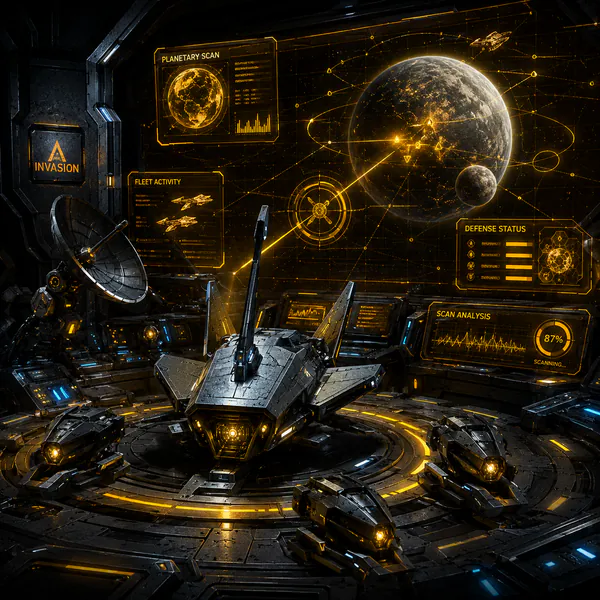
Espionage and counter-espionage
When you spy, your Spy technology is compared with your target's: if yours is higher, your reports become more complete – if it is lower, you learn less. You can make up for missing levels with more probes. The rule of thumb from the game: at equal levels, three Spy probe are enough for a full report, and every level you are behind costs three more probes (Espionage).
Spotting incoming fleets
The higher your Spy technology, the more precisely you see foreign fleets heading for your planets: first nothing at all, then the number of ships, later the ship types and finally the exact composition.
The Stealth bomber is a special case: according to the game description, the detectors of the attacked planet can only pick it up halfway through its flight – and even a high Spy technology doesn't change that.
Spy technology is also required for the Spy probe and the Jammer probe (level 2), the EMP-Bomb (level 4) and the Stealth bomber (level 8).
Background
The development of spy technology is crucial for pilots in SpaceInvasion, since better equipped spy probes and better counterespionage systems can bear tactical advantages. Advancement in this technology allows that more information can be gathered about an opponent. The chances of receiving a complete spy report increase with every level above an opponent's level in this technology. The level of defense against espionage will also increase for every level in this technology above the level in this technology held by an opponent. In general you need 3 probes when your oponent has an equal level of espionage technology and for each level difference you need another 3 probes to receive a full espionage report.
Levels at a glance
| Level | Metal | Kryptonite | Spice | Research time |
|---|---|---|---|---|
| 1 | 500 | 2,000 | 300 | 6 min 36 s |
| 2 | 1,000 | 4,000 | 600 | 13 min 12 s |
| 3 | 2,000 | 8,000 | 1,200 | 26 min 23 s |
| 4 | 4,000 | 16,000 | 2,400 | 52 min 47 s |
| 5 | 8,000 | 32,000 | 4,800 | 1 h 45 min |
| 6 | 16,000 | 64,000 | 9,600 | 3 h 31 min |
| 7 | 32,000 | 128,000 | 19,200 | 7 h 2 min |
| 8 | 64,000 | 256,000 | 38,400 | 14 h 4 min |
| 9 | 128,000 | 512,000 | 76,800 | 1 d 4 h 8 min |
| 10 | 256,000 | 1,024,000 | 153,600 | 2 d 8 h 17 min |
| 11 | 512,000 | 2,048,000 | 307,200 | 4 d 16 h 35 min |
| 12 | 1,024,000 | 4,096,000 | 614,400 | 9 d 9 h 11 min |
| 13 | 2,048,000 | 8,192,000 | 1,228,800 | 18 d 18 h |
| 14 | 4,096,000 | 16,384,000 | 2,457,600 | 35 d 23 h |
| 15 | 8,192,000 | 32,768,000 | 4,915,200 | 35 d 23 h |
| 16 | 16,384,000 | 65,536,000 | 9,830,400 | 35 d 23 h |
| 17 | 32,768,000 | 131,072,000 | 19,660,800 | 35 d 23 h |
| 18 | 65,536,000 | 262,144,000 | 39,321,600 | 35 d 23 h |
| 19 | 131,072,000 | 524,288,000 | 78,643,200 | 35 d 23 h |
| 20 | 262,144,000 | 1.05 B | 157,286,400 | 35 d 23 h |
| 21 | 524,288,000 | 2.10 B | 314,572,800 | 35 d 23 h |
| 22 | 1.05 B | 4.19 B | 629,145,600 | 35 d 23 h |
| 23 | 2.10 B | 8.39 B | 1.26 B | 35 d 23 h |
| 24 | 4.19 B | 16.78 B | 2.52 B | 35 d 23 h |
| 25 | 8.39 B | 33.55 B | 5.03 B | 35 d 23 h |
| 26 | 16.78 B | 67.11 B | 10.07 B | 35 d 23 h |
| 27 | 33.55 B | 134.22 B | 20.13 B | 35 d 23 h |
| 28 | 67.11 B | 268.44 B | 40.27 B | 35 d 23 h |
| 29 | 134.22 B | 536.87 B | 80.53 B | 35 d 23 h |
| 30 | 268.44 B | 1.07 T | 161.06 B | 35 d 23 h |
| 31 | 536.87 B | 2.15 T | 322.12 B | 35 d 23 h |
| 32 | 1.07 T | 4.29 T | 644.25 B | 35 d 23 h |
| 33 | 2.15 T | 8.59 T | 1.29 T | 35 d 23 h |
| 34 | 4.29 T | 17.18 T | 2.58 T | 35 d 23 h |
| 35 | 8.59 T | 34.36 T | 5.15 T | 35 d 23 h |
Values without speed-up. Set your research lab level above and the research times adjust.